Dow, S&P 500, Nasdaq sink as bond yields jump to cap volatile week ahead of Nvidia earnings

Dow, S&P 500, Nasdaq sink as bond yields jump to cap volatile week ahead of Nvidia earnings


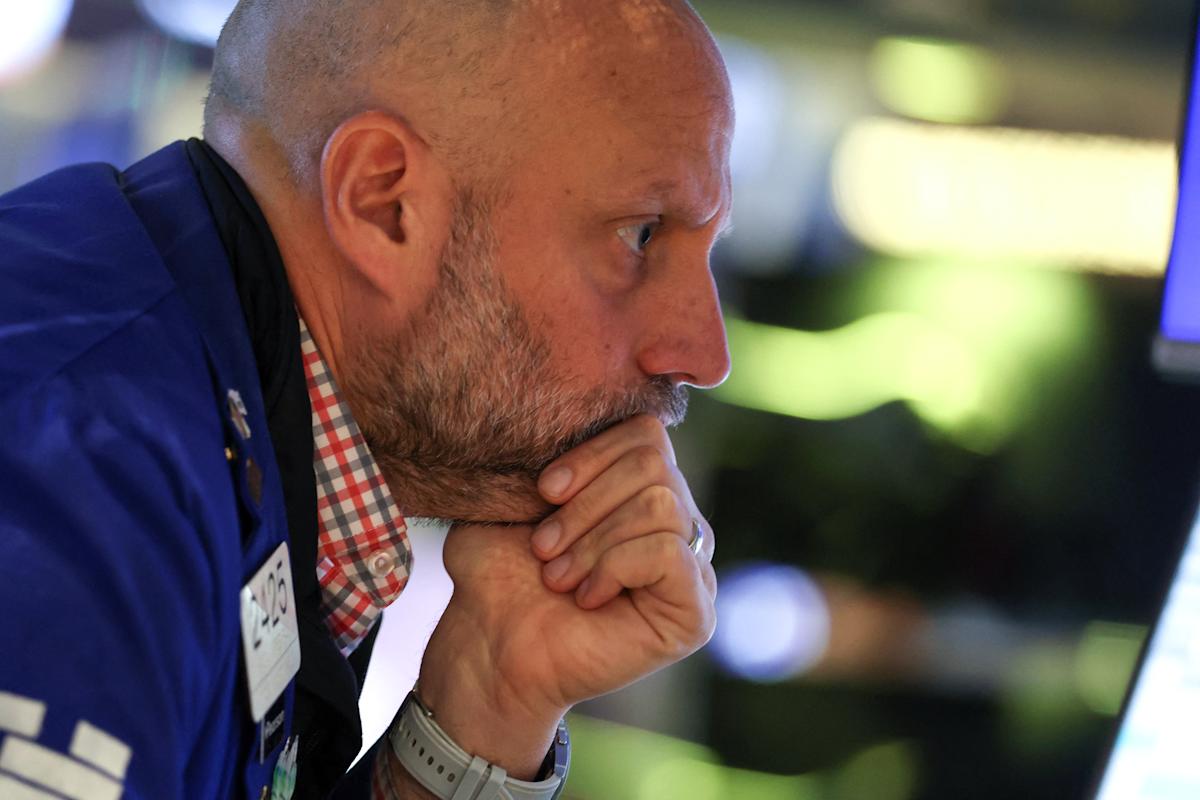
US stocks sank on Friday, retreating from record highs as rising bond yields and inflation worries preyed on markets and investors were gauging the success of the Trump-Xi summit in China.

The tech-heavy Nasdaq Composite (^IXIC) slid 1.5%, dragged lower by a 4% decline in Nvidia (NVDA), which reports earnings next week, and pressure on other chip stocks.

The S&P 500 (^GSPC) fell 1.2% after surging to all-time closing highs on Thursday, while the Dow Jones Industrial Average (^DJI) lost 1%, or 530 points, and dropped back below 50,000 as stocks came under pressure.

Stocks pulled back as a global bond rout weighed on sentiment to end the week, with the benchmark 10-year Treasury yield (^TNX) climbing to 4.59%, and the 30-year yield (^TYX) reaching 5.13%.

Investors also assessed the geopolitical backdrop as President Trump concluded his visit with Chinese counterpart Xi Jinping in Beijing. The two-day summit struck a business-friendly tone, involving 16 top US executives and delivering new deals for the likes of Boeing (BA) and Nvidia (NVDA).

However, the diplomatic issues of Taiwan and Iran continued to lurk in the background. US officials hoped that China could help end the war with Iran by using its influence with its major oil supplier. Trump said China and the US “feel very similar about Iran,” but Xi struck a more measured tone.

The lack of progress toward peace has stoked concern about the conflict’s price pressures, shown in this week’s US inflation readings. Oil futures rose over 2%, with Brent (BZ=F) trading around $109 a barrel.

LIVE COVERAGE IS OVER 14 updates

  • Nasdaq, Dow end week with slight losses after a losing day on Wall Street

    Stocks closed lower on Friday as inflation concerns and the prospect of Federal Reserve rate cuts weighed on equities and pushed bond yields higher.

    The Nasdaq Composite (^IXIC) fell 1.5% and slipped into negative territory for the week. Pressure on chip stocks weighed on the tech-heavy index.

    The S&P 500 (^GSPC) fell 1.2%, retreating from all-time highs but managing to post a slight gain for the week.

    The Dow Jones Industrial Average (^DJI) lost 1% and erased Thursday’s gains to end the week lower.

    The 30-year yield (^TYX) ended the day at its highest closing price since 2007, while the 10-year yield (^TNX) climbed to its highest level in a year.

  • Stocks regain some ground but are still heading for a downbeat end to the week

    Stocks regained some ground on Friday afternoon, driven by a bounce-back in tech, but markets were still headed for a downbeat close for the week.

    The Technology Select Sector SPDR ETF (XLK) came back from session lows, trimming losses to 0.5%. Shares of semiconductor stocks like Nvidia (NVDA) were under pressure, while software names took a leg higher.

    Energy (XLE) was the lone sector in the green as crude oil prices moved higher. West Texas Intermediate crude, the US benchmark, topped $100 again, while Brent (BZ=F) traded above $109 per barrel. The biggest laggard was Basic Materials stocks (XLB).

    The three major indexes trimmed some of their losses but were still down close to 1%. Despite briefly surpassing the 50,000 level earlier this week for the first time in months, the Dow Jones Industrial Average (^DJI) was pacing for a flat close to a slight decline for the week.

  • LeBron James was on the Cleveland Cavaliers the last time Nike stock traded at these lows

    Yahoo Finance’s Brian Sozzi reports:

    In September 2014, Nike (NKE) athlete LeBron James returned to his hometown team, the Cleveland Cavaliers, after four seasons with the Miami Heat.

    Around that time, on Sept. 25, Nike stock closed at $39.88. It marked a closing low for the shares that hasn’t been seen since. But it’s a level Nike is quickly closing in on today.

    On Thursday, Nike stock took out its prior 52-week low of $42.09, set on April 13, as a nasty post-earnings slide continues to rage. Shares are down 34% year to date compared to a roughly 10% gain for the S&P 500 (^GSPC).

    To put it in context, Nike’s all-time high closing price was $177.51 on Nov. 5, 2021. From that peak to today’s low of around $42, the stock has fallen over 75% — an extraordinary destruction of shareholder value for one of the most iconic brands in the world.

    The five-year return on Nike stock is -69% — meaning investors who bought five years ago have lost two-thirds of their money.

    Read more here.

  • Brown-Forman reportedly rejects Sazerac’s takeover bid

    Brown-Forman (BF-B, BF-A) stock ticked higher on Friday after the Wall Street Journal reported that the Jack Daniel’s maker rebuffed a takeover offer by Sazerac.

    According to the Journal, Brown-Forman rejected a cash offer of $32 per share that would have valued the company at roughly $15 billion. The takeover attempt was reportedly backed by Wells Fargo and Apollo Global Management. (Disclosure: Yahoo is a portfolio company of funds managed by affiliates of Apollo Global Management.)

    Class B shares were trading around $26 each on Friday. The Brown family controls most of the voting shares of the stock. Sazerac, which makes a namesake liquor and Fireball whisky, is privately owned and family-owned.

    Rumors of consolidation in the industry have swirled as drinking rates in the US have fallen.

  • The 30-year Treasury yield just reached its highest level in almost 20 years

    Surging Treasury yields amid a sell-off in global bonds sent the stock market a warning on Friday.

    The 30-year Treasury yield (^TYX) rose 10 basis points to reach 5.12%, its highest level since June 2007. The 10-year benchmark yield (^TNX), meanwhile, climbed 11 basis points to 4.57%, its highest level since May 2025. Bond yields and prices move in opposite directions, meaning that when yields rise, prices fall.

    Both bonds broke above the key psychological levels of 5% and 4.5%, respectively. As Yahoo Finance’s Jared Blikre has written before, the 5% zone for the so-called long bond represents a danger zone that has tightened financial conditions in the past.

    Concerns about rising inflation and hawkish Federal Reserve policy appeared to be behind the move in bonds on Friday.

  • Jake Conley

    Carlyle’s Jeff Currie: We are at the start of the next commodities supercycle

    The market is at the start of the next commodity supercycle, according to energy strategist and investor Jeff Currie of Carlyle Group.

    In a thread posted to X Friday morning, Currie laid out a multipronged argument for why the market is right at the beginning of the next years-long rally cycle for commodities.

    First, the AI trade, for which the “Magnificent Seven” companies are expected to spend more than $700 billion on capital expenditures in 2026 alone, faces major physical bottlenecks.

    Second, the market is swinging increasingly toward deglobalization, moving in the opposite direction of the last commodities supercycle that began in the early 2000s with China’s emergence on the world stage as a major economic power and the increasing interconnection of international markets.

    In an environment of deglobalization, Currie argued, supply chains get tighter and competition for an increasingly small supply of resources increases.

    “The 2000s super cycle was HAGO — Hard Assets, Global Operations. China assembling, Russia piping, dollars recycling, everything moving across borders frictionlessly,” Currie wrote. “That regime is dead.”

    His closing argument: “Get long. Buckle in. Hang on for the ride.”

  • Stocks sink at the open, bond yields and dollar rise

    Stocks opened lower on Friday as rising bond yields and inflation concerns weighed on markets.

    The tech-heavy Nasdaq Composite (^IXIC) fell 1.3% at the open, dragged down by a 3% decline in Nvidia (NVDA) shares.

    The S&P 500 (^GSPC) dropped 1%, dipping below the 7,500 level notched on Thursday, while the Dow Jones Industrial Average (^DJI) lost 0.8% to fall back below its 50,000 milestone.

    Bonds were in focus as Treasury yields, which move inversely to prices, moved higher. The 10-year Treasury yield (^TNX) traded at 4.56%, and the 30-year yield (^TYX) rose to 5.11%.

    The US dollar index (DX-Y.NYB) climbed to 99, its highest level in over a month.

  • Gold, silver, and copper sink as yields rise

    Metals sank on Friday morning as higher inflation expectations came to the forefront, lifting bond yields and the dollar and putting pressure on the safe-haven assets.

    Gold (GC=F) prices fell 2.7% to $4,555 a troy ounce, while silver (SI=F) dropped 8% to $78 an ounce. Silver’s downswing over the past two days halted its rally in the first half of the month.

    Copper (HG=F) also reversed gains, falling about 5% on Friday.

    Oil prices rose following the conclusion of President Trump’s visit to China, which yielded little movement on the Strait of Hormuz from Chinese President Xi Jinping. That has raised concerns that the strait will remain blocked and lead to sustained high inflation, which could delay Federal Reserve rate cuts.

  • The stock market rally has history on its side — and one big dot-com caveat

    Two market history studies are telling very different stories about this rally, notes Yahoo Finance’s Jared Blikre in today’s Chart of the Day.

    He writes:

    The first one is giving bulls permission to stay in the trade. The SPDR S&P 500 ETF (SPY) just flashed a rare weekly momentum signal, closing above its upper Bollinger Band for the first time in more than a year.

    In plain English: The S&P 500 ETF just surged above its normal trading range — something it’s only done seven prior times since launching in 1993.

    S&P 500 ETF just flashed a rare weekly momentum signal
    S&P 500 ETF just flashed a rare weekly momentum signal · Astra Insights, Yahoo Finance

    … The second study is where the story gets trickier.

    The S&P 500 (^GSPC) has been hitting records with fewer than 60% of stocks trading above both their 50-day and 200-day moving averages, according to Bespoke Investment Group, circulated by the Market Ear.

    The only other period where that combination showed up was from December 1998 through March 2000 — the final stretch of the dot-com melt-up.

    Read more here.

  • Stocks on the move: Applied Materials, Figma, Boeing, Cerebras

    As stock futures start the day in negative territory, here’s a look at some key movers ahead of the opening bell that we’re keeping an eye on:

    Applied Materials (AMAT) shares dipped 1% despite the company sailing past earnings estimates on Thursday afternoon amid strong demand for its chipmaking tools. Applied Material’s third quarter earnings and revenue forecasts also exceeded estimates.

    Figma (FIG) stock jumped 9% after the design platform raised its 2026 revenue outlook to between $1.42 billion and $1.43 billion, up from its prior forecast of $1.36 billion to $1.37 billion.

    Boeing (BA) shares were roughly flat as President Trump and Chinese President Xi Jinping concluded their Beijing summit. The stock slid on Thursday after Trump announced China had ordered 200 planes, a letdown for investors, who had been speculating about a potential “mega deal” in the works.

    Cerebras (CBRS) stock traded lower on Friday morning to follow a stunning 68% pop on its first day of trading. The IPO was priced at $185 per share and opened at $350. The AI chipmaker’s shares closed at $311 apiece on Thursday.

    Check out more trending tickers here.

  • Billionaire investor Bill Ackman takes stake in Microsoft

    Pershing Square founder and Warren Buffett acolyte Bill Ackman disclosed on X on Friday that his hedge fund is taking a stake in Microsoft (MSFT).

    Ackman stated that Microsoft is “a company we have followed for many years now offered at a highly compelling valuation.”

    Ackman added that Microsoft’s multiple does not reflect the value of its 27% stake in OpenAI (OPAI.PVT), which he said would be approximately $200 billion, or 7% of Microsoft’s market capitalization.

    The move shows dip-buying behavior as Microsoft stock has tumbled 15% year to date, versus a 9% gain in the S&P 500.

    Read more here from Yahoo Finance’s Brian Sozzi.

  • Global bonds tumble as flaring inflation spooks investors

    Reuters reports:

    The global bond market limped to the end of a bruising week on Friday, as growing evidence of economic ‌damage from the Iran war prompts investors to assume interest rates will ‌rise faster than expected and growth will suffer.

    U.S. Treasury yields hit their highest since in around a year ​as traders anticipate the Federal Reserve may need to hike rates to rein in inflationary pressures stemming from Iran war-fuelled energy shocks.

    German, Italian and French bonds came under fire in early European trading, while Japanese bond yields hit record highs.

    … Inflation ⁠data this week has shown consumers and businesses are starting to see big increases in price pressures as a result of the war, which has pushed up the price of ​crude by ​over 50%.

    Read more here.

  • Asian shares fall despite optimism from Xi-Trump meeting

    Reuters reports:

    Asian shares dived on Friday as investor euphoria over tech stocks gave way to inflation fears that saw Treasury yields spike to one-year highs and rising bets on a U.S. rate hike this year.

    MSCI’s broadest index of Asia-Pacific shares outside Japan fell 2.3% and was set for a weekly loss of 1.8%.

    Japan’s Nikkei (^N225) also dropped 1.8% as data showed the country’s wholesale inflation accelerated to 4.9% in April, the fastest pace in three years, leaving the Bank of Japan on track to raise interest rates.

    South Korea’s KOSPI (^KS11) topped ​8,000 ​points for the first time and then crashed, falling by over 5%. China’s blue-chip eased ​0.6%, while Hong Kong’s Hang Seng (^HSI) index fell 1.4%.

    Read more here.

  • Oil on track for week of gains as Hormuz disruption continues

    Bloomberg reports:

    Oil headed for a weekly gain as the crucial Strait of Hormuz remains effectively closed, with efforts to end the war in limbo and disruptions that have upended global markets set to linger.

    Brent (BZ=F) crude rose toward $107 a barrel, with futures up around 5% this week. West Texas Intermediate (CL=F) was near $102. A US naval blockade of Iran’s ports remains in place, while the waters in the region continue to be treacherous for mariners. A commercial vessel was seized by unauthorized personnel at the entrance to the strait and taken into Iranian waters.

    US President Donald Trump met with Chinese leader Xi Jinping on Thursday, and the two discussed keeping Hormuz open to support energy trade, along with improving American oil flows to the Asian nation, according to a White House official. China’s official readout of the meeting did not include energy among the topics discussed, but it did say the Middle East was addressed.

    The war has driven global oil inventories down at a record pace, and the market will remain “severely undersupplied” until October even if hostilities end next month, the International Energy Agency said this week. US data released on Tuesday underscored how the conflict is reigniting inflation, piling domestic pressure on Trump ahead of the midterm elections in November.

    Read more here.


Source link

Leave a Reply

Your email address will not be published. Required fields are marked *